
Why More Malaysian F&B Businesses Are Going Cashless in 2026


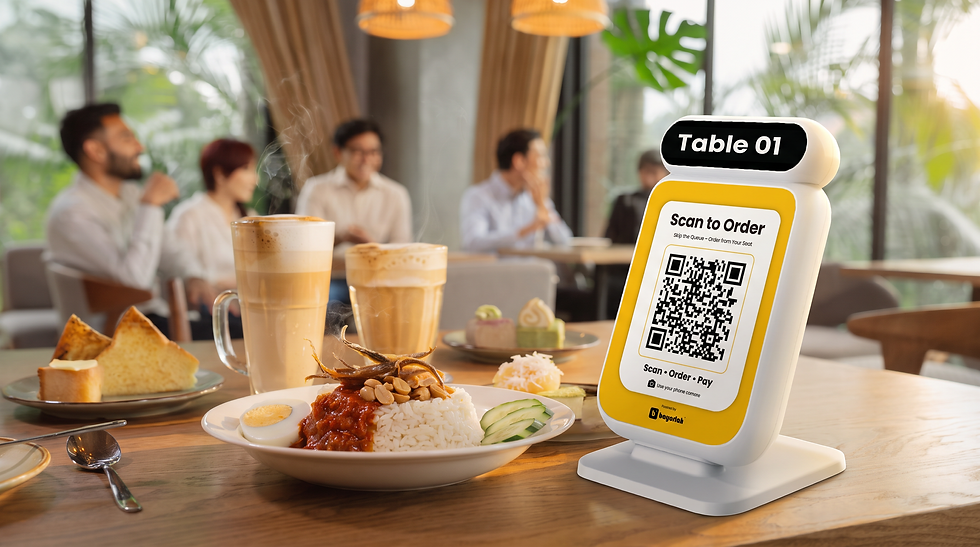
Walk into any café or restaurant in Malaysia today and you'll likely see it: a small QR code on the table, a "Scan • Order • Pay" sign, and customers checking out without ever flagging down a waiter. Cashless isn't a trend anymore — for many F&B businesses, it's becoming the default way customers expect to pay. It's part of a bigger shift — Malaysian F&B businesses are going cashless faster than ever, driven by customer habits, compliance rules, and the cost of slow service.
Why Malaysian F&B Businesses Are Going Cashless
A few things are pushing small business owners toward digital payments faster than ever:
Customer expectations have changed. Diners are used to scanning, ordering, and paying from their phones — especially younger customers who rarely carry cash at all.
Queues cost money. Every minute a customer waits to order or pay is a minute of lost table turnover during peak hours. Digital ordering removes that bottleneck.
Compliance is catching up. With e-invoicing requirements from LHDN rolling out across more business categories, having a payment system that's already built for compliance saves a real headache later.
Cross-border spending is growing. With QR payment networks now supporting travellers from countries like Indonesia, Singapore, Thailand, and China, merchants who accept cross-border QR payments can capture tourist spending they'd otherwise miss.
What "Going Cashless" Actually Looks Like
For most F&B outlets, it's not an all-or-nothing switch. It usually starts with:
Accepting DuitNow QR and major e-wallets alongside cash
Letting customers scan, order, and pay directly from their table — reducing reliance on staff for every step
Getting a real-time dashboard of transactions instead of reconciling manually at the end of the day
This is exactly what a solution like Smart Store is built for — letting customers scan a QR code, browse the menu, order, and pay straight from their phones, while you get a live view of transactions without adding extra hardware complexity.
Is It Worth It for a Small Outlet?

The upfront question every owner asks is whether the cost is worth it. The honest answer: it depends on your setup, but the ongoing savings tend to add up — fewer order mistakes, faster table turnover during peak hours, and less staff time spent taking and re-confirming orders manually.
The Takeaway
Going cashless isn't about chasing a trend — it's about matching how your customers already want to pay, while giving yourself cleaner records and faster service in the process. If queues, order mistakes, or manual reconciliation are eating into your margins, it may be worth looking at what a QR-based ordering and payment system could do for your outlet.
Ready to Go Cashless?
Smart Store gives you QR table ordering, direct e-wallet and DuitNow QR payments, and a real-time business dashboard — with no monthly fees and lifetime access on a one-time payment. Learn more at bayarlah.my or get in touch with bayarlah to start your journey today.


I was looking into Icefish and quickly found that the title is usually listed as Ice Fishing https://icefishing-demo.net/. That helped clear up some confusion, because I initially expected a classic reel-based game. It is actually much closer to a fast wheel experience from Evolution, with a 53-segment wheel and three fishing-themed Bonus rounds. I like the simple structure: choose a bet spot, watch the wheel and see whether a multiplier appears. The three rounds, Lil’ Blues, Big Oranges and Huge Reds, give the format some variety. There is also a free demo, which I think is the best way to understand the mechanics before deciding whether this style suits you. The advertised maximum is 5,000x, while the published RTP can…